Have you ever stood beside something truly enormous and felt that little drop in your stomach, like your brain is trying to recalibrate? Big measurements do that. They don’t just impress, they put you in your place in the nicest possible way.
When we start talking about things around 500 feet long or tall, we’re in a category that feels larger than life. Not quite “mega-skyscraper” territory, but far beyond anything ordinary. It’s that sweet spot where human ambition and real-world scale collide.
How Long Is 500 Feet?
500 feet equals about 152.4 meters, or roughly 1⅔ American football fields laid end-to-end (counting the 300 feet between goal lines). In more everyday terms, it’s like walking about a block and a half in many U.S. cities, or lining up around 83 average adults head-to-toe.
At highway speed (about 70 mph), a car covers 500 feet in roughly 3.4 seconds, which is why road designers and safety experts care about distances like this more than you’d think.
Now, here are some striking examples that land near this scale, each memorable for different reasons.
1. The Washington Monument

Rising 555 feet, the Washington Monument edges past the 500-foot mark and still dominates the National Mall skyline. Completed in 1884, it was the tallest structure in the world until the Eiffel Tower took over a few years later.
A detail many visitors miss: partway up, the stone color shifts slightly. Construction paused for years, and when work resumed, the new marble didn’t match perfectly. The result is a subtle two-tone band that quietly marks a turbulent chapter in U.S. history.
Even more impressive is how it was built. Long before today’s cranes and modern equipment, workers raised enormous stone blocks using pulleys and steam-powered systems, proving that “no technology” doesn’t mean “no engineering.”
2. Space Needle in Seattle

Seattle’s Space Needle climbs to 605 feet, built for the 1962 World’s Fair as a symbol of space-age optimism.
Its iconic shape wasn’t just for style. Engineers designed it to handle extreme wind and serious seismic activity. It’s meant to move. In an earthquake, that flexibility helps it survive what rigid structures might not.
From the observation deck, the 360-degree view makes the number “500+ feet” feel real in a way measurements on paper never do.
3. The Gateway Arch in St. Louis
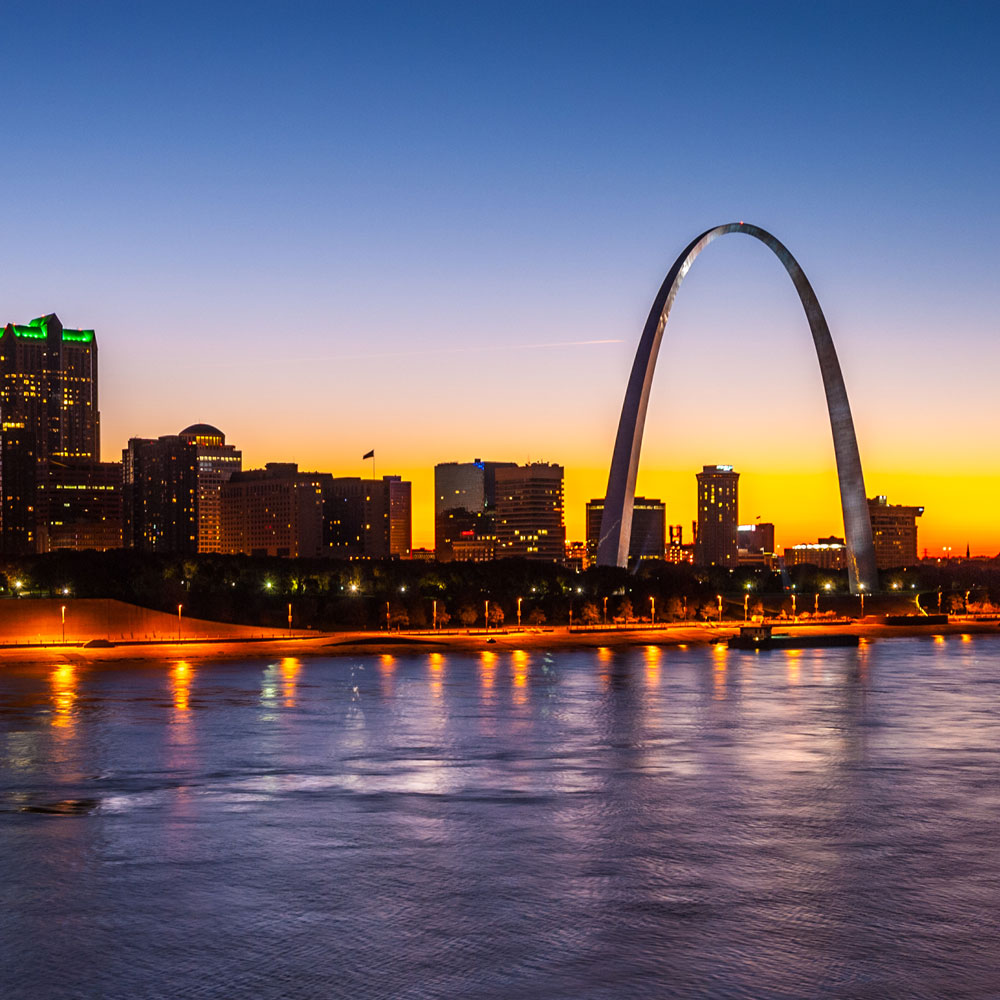
The Gateway Arch reaches 630 feet above the Mississippi River and remains the tallest arch in the world. Designed as a weighted catenary curve, it’s a rare mix of art and math that feels almost unreal in person.
One satisfying detail: the arch is as tall as it is wide, which gives it a perfectly balanced silhouette despite its massive scale.
It also sways on purpose. In strong winds, it can move noticeably, because controlled flexing is safer than fighting the force head-on. Visitors can ride a tram system inside the legs to an observation area near the top for an up-close lesson in scale.
4. Statues of Liberty (Including Pedestal)
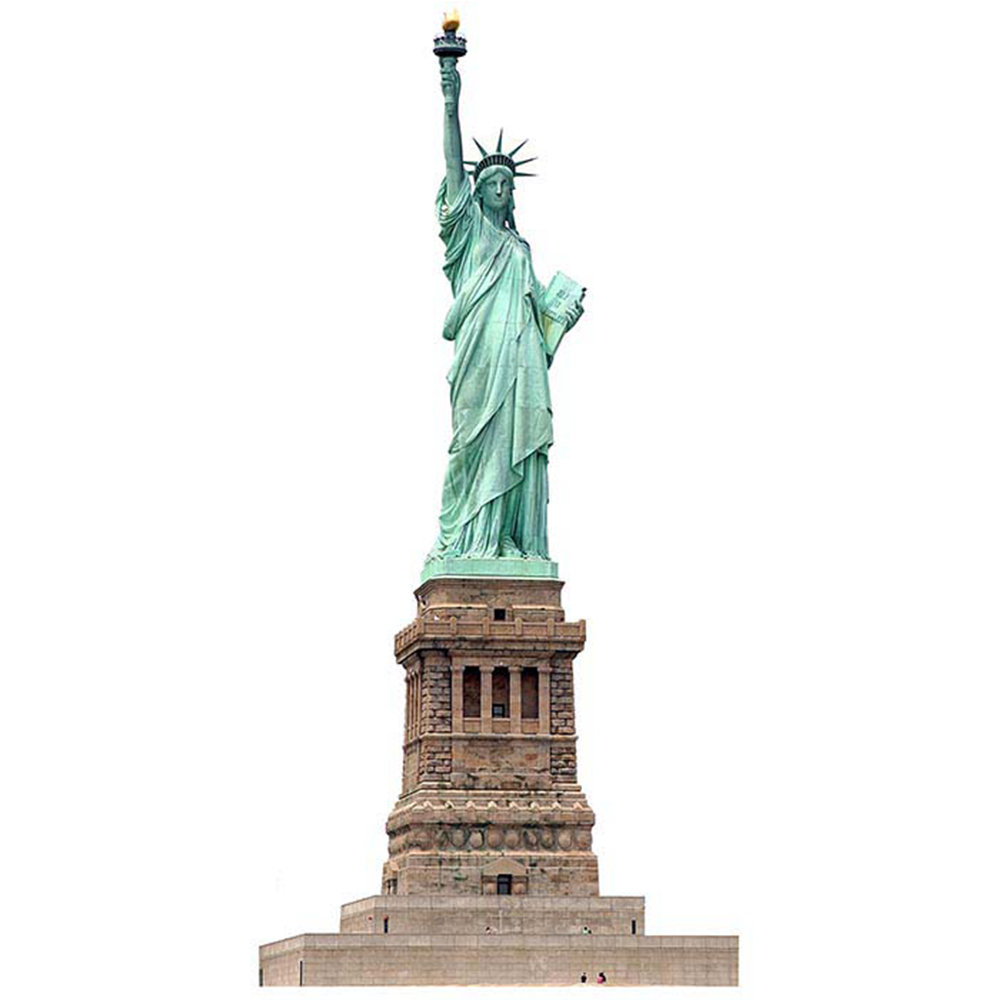
From ground level to torch, the Statue of Liberty stands about 305 feet when you include the pedestal. The statue itself is 151 feet, and the pedestal adds another 154 feet.
The details are enormous up close: her face is over 8 feet tall, and her index finger alone is roughly 8 feet long. Designed by Frédéric Auguste Bartholdi and structurally engineered with help from Gustave Eiffel, it’s an engineering landmark as much as a cultural one.
While it doesn’t hit 500 feet by itself, it’s a great real-world reference for visualizing what “hundreds of feet” truly means.
See Also: How Long is 6 Feet? 17 Things That Are 6 Ft Long
5. The Great Pyramid of Giza (Original Height)

When first completed around 2560 BCE, the Great Pyramid likely stood about 481 feet tall, extremely close to the 500-foot benchmark. Natural wear and the loss of its outer casing have reduced it to roughly 455 feet today.
It held the title of tallest human-made structure for about 3,800 years, which is absurdly long when you think about it.
Even more mind-blowing is its precision: the base is remarkably level, and the sides align closely with the cardinal directions. It’s made of an estimated 2.3 million stone blocks, many weighing several tons. Standing beside it makes “481 feet” feel less like a number and more like a physical experience.
6. Anaconda Copper Mine Smokestack (Montana)

One of the lesser-known giants, the Washoe Smelter Stack once rose 585 feet above Anaconda, Montana. Built in 1918, it served a major copper-smelting operation and was designed to vent fumes high into the atmosphere.
It was massive even at the base, tapering as it climbed. Though the smelter shut down decades earlier, the stack remained a landmark for years, a towering reminder of industrial America and the environmental trade-offs that came with it.
7. A Loaded Supertanker Ship

Many modern oil tankers easily exceed 500 feet, and some stretch past 1,000 feet. A typical Very Large Crude Carrier (VLCC) can be around 1,100 feet long and carry roughly 2 million barrels of crude oil.
What’s wild is how few people run them. Crews can be as small as 20–30, managing a moving object bigger than most city blocks.
With that size comes inertia: turning can require miles, and stopping distance can be measured in minutes and long stretches of water.
8. Redwood Trees

Coast redwoods (Sequoia sempervirens) are the tallest trees on Earth. While today’s tallest known living redwood, “Hyperion,” stands around 379 feet, historical accounts suggest that some redwoods in the past may have approached or even exceeded 500 feet before large-scale logging eliminated most of the biggest specimens.
They’re not just tall, they’re tough. Their bark resists fire and pests, and their height helps them capture moisture from coastal fog, supporting their own mini-ecosystem.
A redwood grove doesn’t feel like a forest. It feels like architecture built by time.
See Also: Things that Are 100 Feet Long/Tall – Common Objects and Their Sizes
9. Standard Modern Cruise Ships
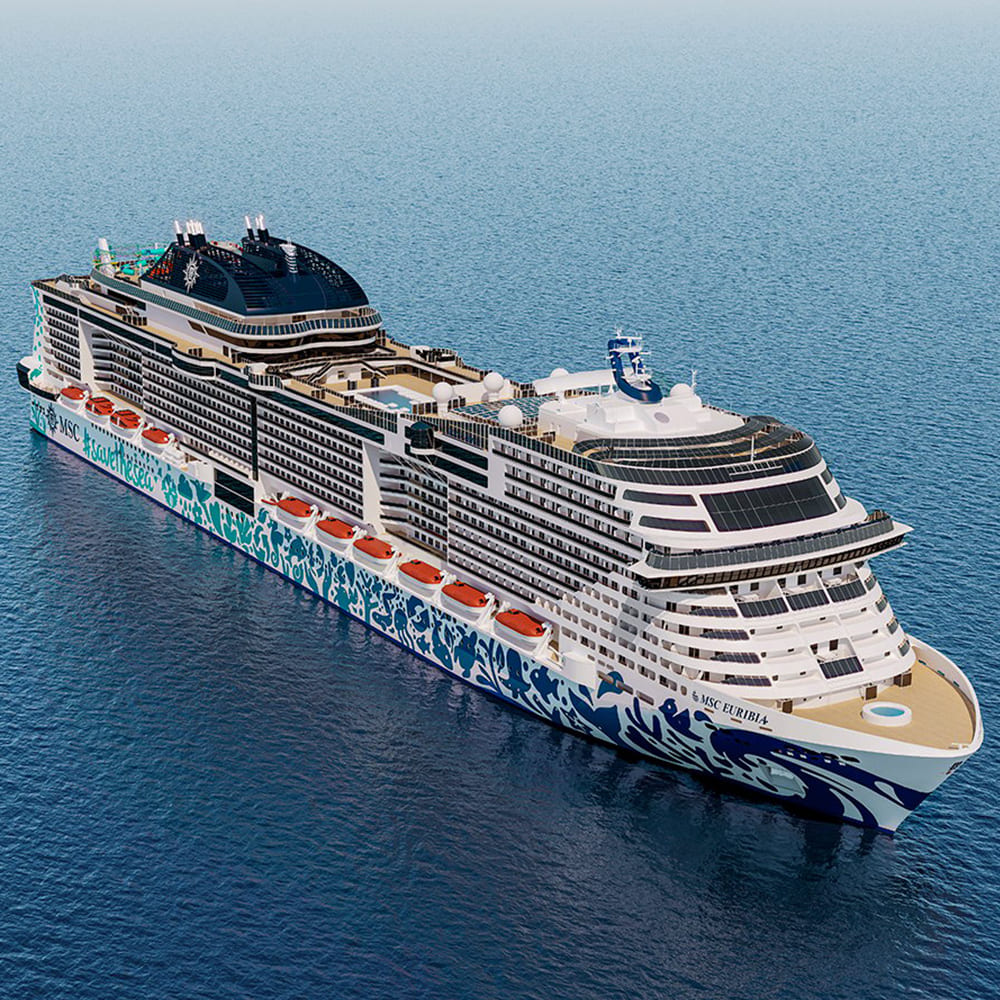
The largest cruise ships now push beyond 1,000 feet, but plenty of traditional “large” cruise ships land near 500 feet, making them perfect scale references.
A ship around this size can carry 1,500–2,000 passengers across multiple decks, with restaurants, theaters, pools, and shopping onboard. The engineering challenge is balancing size with stability, maneuverability, and comfort, all while surviving rough water and tight ports.
10. The SkyWheel in Las Vegas (Under Construction)

Las Vegas has floated proposals for giant observation wheels in the 500+ foot range, often reported around 550 feet. Modern wheels of this type typically use enclosed, climate-controlled capsules rather than open seats, turning the ride into a moving observation deck.
Whether built or not, a 500-foot wheel is easy to imagine: it becomes visible from all over the city, basically instant skyline status.
11. An Average City Block (In Many Cities)

In many American grid-based cities, a “standard” block often falls somewhere in the 300–900 foot range depending on the city. In several places, the long side of a block lands near 500 feet, which is part of why that distance feels familiar even if we don’t consciously measure it.
City planners like this scale because it balances walkability and efficient land use. Too long and people hate walking it. Too short and you create constant intersections and traffic friction.
How to Visualize 500 Feet in Real Life
If you need to estimate 500 feet without tools:
- Count steps: Average stride is about 2.5 feet, so ~200 steps is close to 500 feet.
- Use a football field: 500 feet ≈ 1⅔ goal-line-to-goal-line football fields.
- Time your walk: At a normal pace, 500 feet takes about a minute.
- Use blocks: In many cities, it’s roughly half of a longer block or one full shorter block.
- Think landmarks: A bit shorter than the Great Pyramid’s original height, and a bit shorter than the Washington Monument.
Why This Measurement Is Actually Useful
Understanding what 500 feet looks and feels like helps more than you’d expect:
- Property and land: Helps you picture lot depth, frontage, or walking distances.
- Safety and evacuation: Emergency guidance often uses distances like this.
- Photography: Knowing how far 500 feet is improves lens and framing choices.
- Construction planning: Large-site layouts and material staging make more sense.
- Driving awareness: Many safety calculations and spacing rules live in the “hundreds of feet” zone.
Conclusion
Five hundred feet is a fascinating threshold: big enough to feel epic, but still human-scale enough to grasp. It’s where structures stop being “tall” and start feeling like events.
Once you train your eye for it, you’ll notice 500-foot scale all around you: towers, bridges, hillsides, ship lengths, even the way cities are laid out. Recognizing that size adds a new layer of appreciation to the built world and the natural one.