Key Takeaways
- Automating payroll enhances accuracy and efficiency.
- Key components include AI integration and cloud-based systems.
- Implementation requires careful planning and employee training.
Table of Contents
- Introduction
- Benefits of Payroll Automation
- Key Components of Automated Payroll Systems
- Implementing Payroll Automation
- Challenges and Solutions
- Future Trends in Payroll Automation
- Conclusion
As businesses evolve in a technology-driven landscape, the need for streamlined and accurate payroll processes has become more pressing than ever. Manual payroll methods are being rapidly replaced by advanced solutions that deliver speed, compliance, and reliability for organizations seeking a competitive edge. Exploring automation not only reduces the burden on internal teams but also grants better oversight, fewer errors, and increased employee satisfaction. For companies evaluating new payroll solutions, options like ADP payroll options showcase how simplified processes can be adapted to unique business needs. Automation reduces tedious administrative work, ensures compliance with the latest tax and labor regulations, and offers real-time access to payroll data. Embracing payroll automation can future-proof business operations and provide a vital foundation for scaling with confidence. Companies gain a substantial advantage by mitigating the risks associated with outdated processes, including compliance failures and employee frustrations resulting from payroll errors.
Payroll automation is essential for businesses of all sizes, providing tools that integrate with existing accounting and HR systems. It helps organizations comply with evolving tax codes and employment laws, reducing both costs and errors. Modern payroll systems allow secure access to sensitive information from anywhere, employing advanced encryption and multi-factor authentication. Manual payroll processes pose risks of errors and compliance failures, whereas automation enhances data handling and processing speed to meet the growing demands of regulations. Companies can ensure timely and precise compensation while protecting sensitive information by adopting automated solutions.
Benefits of Payroll Automation
Increased Accuracy: Automation reduces manual mistakes in wage calculation, overtime, benefits, and deductions. This accuracy ensures employee trust and decreases the likelihood of regulatory penalties. It also streamlines data validation, reducing discrepancies that typically require time-consuming corrections. As a result, payroll teams experience fewer disputes from employees. Ultimately, companies gain a more reliable and transparent payroll process.
Time Efficiency: With core processes completed in minutes instead of hours, payroll teams spend less time on repetitive tasks and more on value-added activities.
Compliance Assurance: Automated systems can be programmed to stay updated with ever-changing labor laws and tax rates, massively cutting the risk of costly mistakes. For more information on staying compliant in a changing environment, refer to the Society for Human Resource Management’s guide.
Cost Savings: By minimizing manual intervention, companies reduce labor expenses, paper usage, and accounting service fees.
Key Components of Automated Payroll Systems
- Artificial Intelligence (AI): AI-driven systems boost accuracy by detecting anomalies and automating compliance with tax codes and wage laws, thus reducing audit risk and streamlining processing cycles. They can also predict potential errors before they occur, improving overall payroll reliability. Additionally, AI enables real-time decision-making by analyzing trends in workforce data. Over time, organizations benefit from greater operational efficiency and long-term scalability.
- Cloud-Based Platforms: Cloud systems provide centralized, always-available access to payroll and employee data, simplifying the process for distributed workforces and facilitating easy automatic updates to software.
- Integration Capabilities: Effective payroll solutions natively integrate with HR and accounting systems for seamless data flow and consolidated reporting, minimizing double entry and data inconsistencies.
Implementing Payroll Automation
Assess Needs: Audit current processes to detect inefficiencies, compliance gaps, and manual workloads that could benefit from automation.
Choose the Right System: Select a solution tailored to your business’s scale, industry, and region, taking into account local tax codes, shift structures, and workforce distribution.
Plan the Transition: Develop an implementation roadmap that covers data migration, new workflows, communication plans, and training schedules. Collaboration among payroll, HR, and IT teams is essential for success.
Train Employees: Provide comprehensive training to ensure teams understand new interfaces, processes, and protocols for handling exceptions.
Monitor and Optimize: Track performance through system dashboards and user feedback, regularly adjusting settings and processes to achieve peak efficiency.
Challenges and Solutions
- Data Security Concerns: Organizations must incorporate encryption, secure access controls, and multi-factor authentication to protect employee and company data. Regular security audits further strengthen system defenses and identify emerging vulnerabilities. Training staff on cybersecurity best practices also helps prevent accidental breaches. Together, these measures create a proactive approach to safeguarding sensitive payroll information.
- Integration Issues: Engage with technology partners to ensure a seamless linkage between payroll, HR, and financial systems, and thoroughly test all integrations before launch.
- Employee Resistance: Clear, consistent communication is critical. Involve employees early, demonstrate the benefits of the new system, and foster feedback to facilitate a smooth adoption.
Future Trends in Payroll Automation
- Advanced AI Applications: AI and machine learning are advancing, providing improved analytics and personalized payroll insights for management and staff. These tools can forecast labor costs with greater accuracy, helping organizations make proactive budgeting decisions. They also automate complex compliance tasks that traditionally required manual oversight. As AI evolves, payroll teams will increasingly rely on real-time intelligence to inform their strategic planning.
- Blockchain Integration: With heightened security and transparency, blockchain promises tamper-proof payroll records and faster, verifiable transactions.
- Mobile Accessibility: Mobile-friendly payroll platforms empower employees to access and manage payroll data anywhere, promoting flexibility and engagement in remote and hybrid work models.
Conclusion
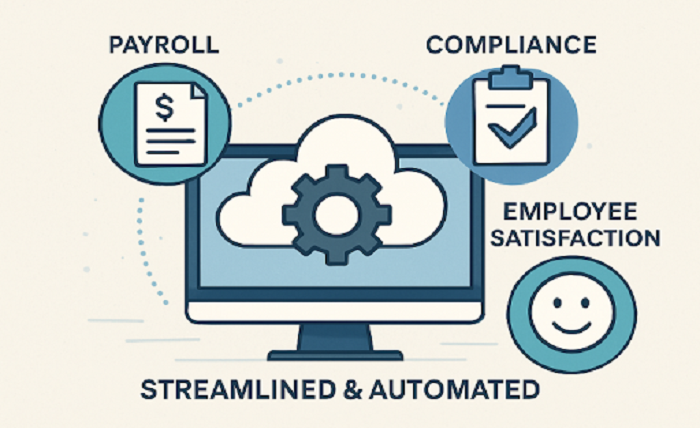
Payroll automation is now a business imperative, delivering substantial gains in efficiency, compliance, and employee satisfaction. As technology advances, companies that proactively implement sophisticated payroll systems position themselves for growth and stability amid an ever-evolving regulatory landscape. Careful planning, the right technology, and strong employee engagement are essential for a successful transition into the next era of payroll management.