Chess and checkers have been quietly dominating tabletops for centuries, turning simple grids into arenas of strategy, rivalry, and the occasional flipped board.
But beneath all that drama sits a very specific question most people never ask: why do these boards work so well in the first place?
Whether you’re building your own board, buying a serious set, or just curious about the quiet math behind classic games, checker board dimensions matter far more than they appear to.
How Big Is a Standard Checker Board?
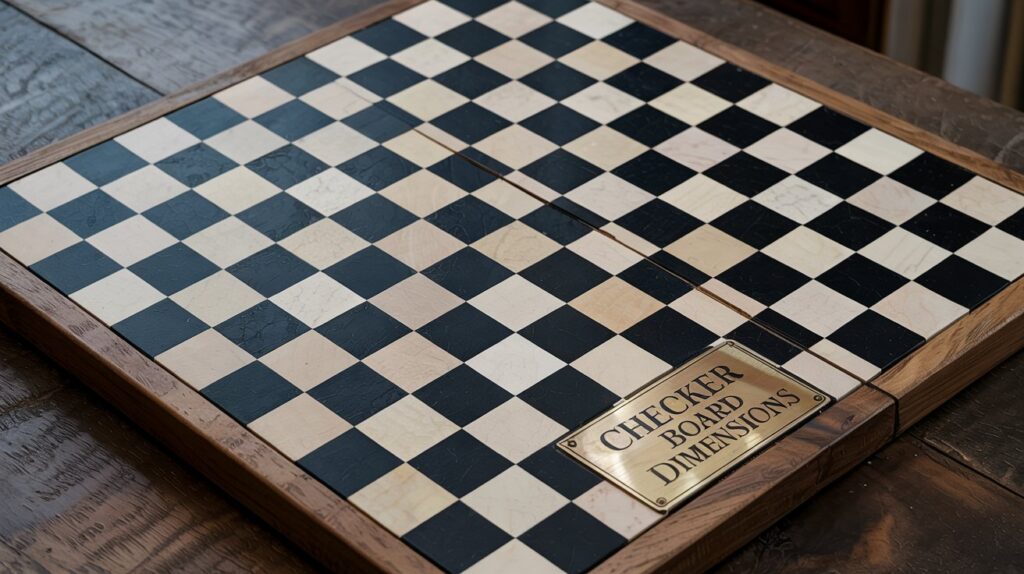
A standard checker board uses an 8×8 grid, creating 64 perfectly proportioned squares.
In physical terms, most boards measure between 14 and 20 inches square, with tournament-standard boards landing precisely at 16×16 inches for the playable surface.
That size is not accidental. It allows players to see the entire board at once, reach any square comfortably, and move pieces without knocking others over. In short, it’s the sweet spot between visibility and usability.
A Design That Balances Form and Function
The classic checker board is one of the most enduring visual designs ever created. The alternating dark and light squares, traditionally black and red or black and white, create instant clarity and visual balance.
This pattern has survived centuries because it works. It guides the eye, defines movement, and maintains symmetry without distracting from gameplay.
Standard Checker Board Specifications
The 8×8 Grid: The Universal Standard
Every regulation checker or chess board follows the same basic structure:
- 64 total squares (8×8)
- Each square: 2 inches × 2 inches
- Playing surface: 16 inches × 16 inches
- Border frame: adds 1–2 inches on each side
- Standard checker piece diameter: about 1½ inches
These proportions create a precise relationship between board and pieces. Squares are large enough for easy handling, yet compact enough to keep the game tight and focused.
Materials and How They Affect Dimensions
Traditional wooden boards usually include a framed edge, which increases the overall size beyond the playing area. High-quality boards often feature:
- Hardwood surfaces like maple or walnut
- Felt or baize backing to reduce slipping and noise
- Precision-cut squares with tolerances as tight as ±0.5 mm
Modern alternatives, such as foldable vinyl boards or travel sets, preserve the 8×8 grid but reduce square size. Travel boards may shrink squares to as small as ¾ inch while keeping proportions intact.
A Brief History of Checker Board Dimensions
The checkerboard pattern predates modern checkers by thousands of years. Variations of grid boards appeared in ancient civilizations long before standardized sizes existed.
Historical examples include:
- Ancient Egyptian Senet boards with a 3×10 grid
- Roman Latrunculi, ranging from 7×7 to 12×12
- Medieval European variants using 10×10 layouts
By the 15th century, the 8×8 grid became firmly established across Europe, largely due to chess standardization. Its balance, symmetry, and mathematical elegance made it the clear winner.
The Mathematics Behind the Board
The checker board isn’t just visually pleasing. It’s mathematically rich.
Symmetry and Geometry
An 8×8 checker board exhibits:
- Rotational symmetry
- Reflective symmetry across axes and diagonals
- Repeating translational patterns
That’s why it shows up in math classrooms as often as it does in living rooms.
The Wheat and Chessboard Problem
One classic problem places a single grain of wheat on the first square, doubling it on every subsequent square.
By square 64, the total reaches
9,223,372,036,854,775,808 grains, a neat demonstration of exponential growth hiding inside a humble board.
See Also: Pokémon Card Sizes: The Complete Guide
The Knight’s Tour
The famous Knight’s Tour puzzle, where a knight visits every square exactly once, only works cleanly because of the board’s specific dimensions. Change the grid, and the problem changes entirely.
Manufacturing Standards and Precision
For competitive play, small errors matter. Tournament boards must meet strict tolerances:
- Square size variance: ±1 mm
- Surface flatness deviation: no more than 2 mm
- Diagonal measurements must match within 1 mm
Professional manufacturers verify these measurements using digital tools to ensure fairness and consistency.

Cultural Variations in Board Size
While 8×8 dominates globally, some regions use expanded formats:
International Draughts
- 10×10 grid
- Roughly 20×20 inches
- Common in Europe and Russia
Canadian Checkers
- 12×12 grid
- About 24×24 inches
- Uses standard pieces, creating wider spacing
Turkish Dama
- 8×8 grid
- Unique movement rules requiring special markings
These versions show how the core concept adapts without abandoning the alternating-square foundation.
DIY Checker Board Dimensions
If you’re making your own board, precision is everything.
Recommended Specifications
- Squares: 2 inches × 2 inches
- Board thickness: at least ¾ inch
- Allow for wood expansion (about 1/32 inch)
- Add a 1-inch border for strength and aesthetics
Material choice matters. Hardwoods require precision, plywood needs edge finishing, and inlay work demands especially tight tolerances to prevent gaps over time.
Digital Checker Boards
Digital versions keep the same proportions but scale dynamically:
- Mobile boards may use 40–60 pixel squares
- Large touch screens can exceed 100 pixels per square
- Touch interfaces require larger interaction zones
Despite changing screens, the 8×8 structure remains untouched.
Uses Beyond Games
Checker board dimensions appear far outside gaming.
Photography and Film
- Lens calibration
- Visual distortion testing
- VFX reference grids
Computer Vision and AI
- Pattern recognition training
- Algorithm testing
- Spatial measurement benchmarks
Architecture and Design
- Floor tiling
- Facade layouts
- Decorative proportion systems
Perfect proportions travel well, apparently.
Choosing the Right Board Size
Competitive Play
- 16×16 inch playing surface
- 2-inch squares
- Matte, high-contrast finish
Casual and Family Use
- Larger squares (2¼–2½ inches)
- Folding or magnetic boards
- Easy storage
Decorative Display
- Oversized boards up to 24 inches
- Exotic wood combinations
- Wide borders emphasizing craftsmanship
Conclusion
Checker board dimensions aren’t just measurements. They’re the result of centuries of refinement, mathematical balance, and cultural agreement.
Every 2-inch square and every 8×8 grid exists because it works. It feels right in the hands, looks right to the eye, and supports strategy without interference.
So the next time you sit down to play, notice the quiet precision beneath the pieces. You’re using the same proportions players relied on hundreds of years ago.
Ancient design, modern relevance. Annoyingly effective.
Read more knowledgeable blogs on Measure Take.