Have you ever picked up a stack of flashcards to study vocabulary or prep for an exam and wondered whether you were using the right size? Flashcards may look simple, but their dimensions play a bigger role in learning effectiveness than most people realize.
From ultra-portable cards designed for quick reviews to large formats made for classroom instruction, flashcards come in a wide range of sizes, each suited to a specific purpose.
Whether you are a student preparing for finals, a teacher building visual aids, or a language learner expanding your vocabulary, understanding flashcard sizes can make studying more efficient and convenient. Let’s explore this often-overlooked detail of one of education’s most enduring tools.
How Big Are Standard Flashcards?
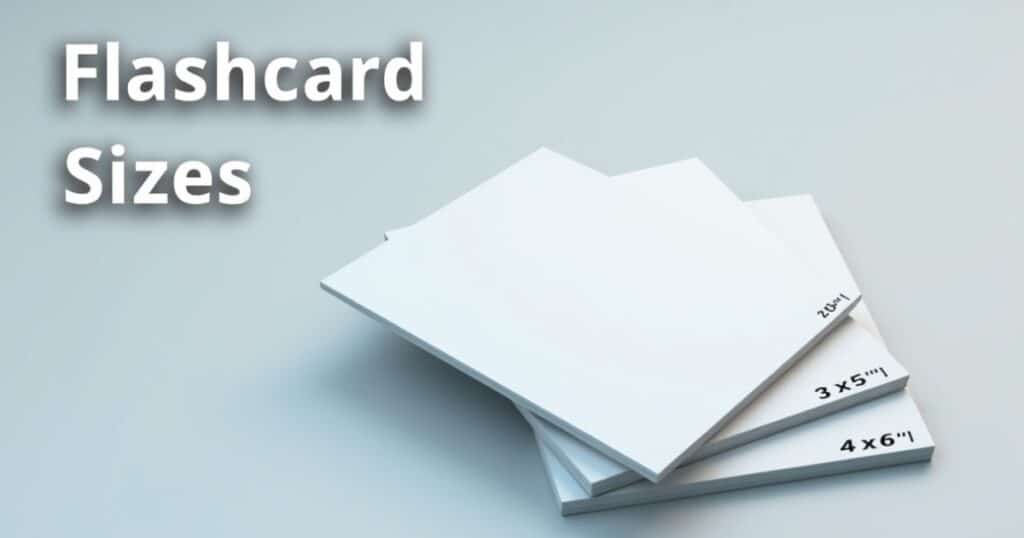
Standard flashcards most commonly measure 3×5 inches (7.6×12.7 cm) or 4×6 inches (10.2×15.2 cm). These sizes have become popular because they strike a practical balance. They provide enough space for clear writing while remaining easy to carry and organize.
You will find these familiar cards in classrooms, backpacks, and study desks around the world, instantly recognizable as tools for memorization and quick review.
Common Flashcard Sizes and Their Uses
Index Card Size (3×5 inches)
The classic 3×5 inch flashcard remains the most widely used size. Its compact shape fits comfortably in the hand and slips easily into pockets, bags, or small storage boxes.
Students frequently use this size for vocabulary, formulas, and key dates. The limited space encourages concise note-taking, forcing information to be broken into manageable pieces. This process itself supports stronger memory retention.
For language learning, these cards are especially effective. One side can hold a word or phrase, while the other displays its meaning or translation. Their portability makes them ideal for short review sessions throughout the day.
Interestingly, this size originated from library index cards in the late 19th century. What began as a cataloging tool eventually became a study staple for generations of learners.
Study Card Size (4×6 inches)
When more writing space is needed without sacrificing portability, 4×6 inch flashcards offer a practical upgrade. They provide significantly more room than 3×5 cards, allowing space for explanations, bullet points, or small diagrams.
Students in fields like medicine or law often prefer this size for topics that require more context. The added area makes it easier to include definitions, examples, and visual cues that clarify complex material.
These cards are well suited for desk-based study sessions and still fit most storage boxes, though they may be less pocket-friendly.
Research has shown that combining text with visual elements can significantly improve recall. The extra space on 4×6 cards makes this approach much easier to apply.
Mini Flashcards (2×3 inches)
Mini flashcards, typically 2×3 inches, may look limited, but they serve specific purposes extremely well.
These cards are ideal for single-word vocabulary, symbols, or short facts. Their small size makes them perfect for studying during short breaks or while commuting. Many learners keep a few in a wallet or phone case for spontaneous review.
Teachers often use mini flashcards for quick classroom activities or games, and they are especially suitable for younger students with smaller hands.
Their biggest advantage is constraint. Because only minimal information fits on each card, learners are encouraged to focus on essentials. This type of ultra-concise learning has been linked to stronger memory formation.
Large Flashcards (5×8 inches)
For topics that demand detail, 5×8 inch flashcards provide ample space. These cards can accommodate diagrams, multi-step explanations, or layered concepts.
Educators frequently use this size for demonstrations, as the text is visible from a distance. They are also helpful for subjects like mathematics, science, or grammar, where multiple examples or processes need to be shown together.
The trade-off is portability. These cards are better suited for structured study sessions rather than quick reviews on the go. Many students reserve them for their most challenging topics, where additional space improves understanding.
Digital Flashcards (Variable Sizes)
Digital flashcards have transformed how people study. Platforms such as Anki, Quizlet, and Brainscape adapt card sizes automatically based on the device being used.
Their biggest advantage is flexibility. Digital cards can include images, audio, animations, and videos, and many apps use spaced repetition systems that optimize review timing for long-term retention.
They also reduce paper use and eliminate physical storage limits. However, studies suggest that handwriting information on physical cards can enhance memory more than typing. As a result, many learners use a hybrid approach, combining physical flashcards for initial learning with digital tools for review and tracking progress.
See Also: Things that Are 3 Meters Long – Size of Common Objects
Specialized Flashcard Formats
Ringed Flashcards
Ringed flashcards include a hole in one corner, allowing them to be bound with a metal ring or clip. This design keeps cards organized and prevents accidental mixing or loss.
They are especially useful for sequential information such as timelines, procedures, or step-by-step processes. Language learners often group vocabulary by theme, while science students may organize related concepts together.
Ringed flashcards are most common in 3×5 and 4×6 sizes and work well when order matters.
Two-Sided Color-Coded Flashcards
Color-coded flashcards use different colors on each side or along the edges to visually separate information. This technique helps learners quickly distinguish questions from answers or categorize material by topic or difficulty.
Research in cognitive psychology suggests that color associations can enhance recall by adding visual memory cues. When information is linked to a specific color, retrieval often becomes faster and more accurate.
Practical Applications of Flashcard Sizes
Academic Studying
Different subjects benefit from different card sizes:
- 3×5 cards for definitions, terms, and basic facts
- 4×6 cards for explanations and examples
- 5×8 cards for diagrams and complex processes
Many students use multiple sizes within the same subject, depending on topic complexity.
Language Learning
Language learners often mix sizes strategically:
- Mini cards for vocabulary
- Standard cards for phrases
- Large cards for grammar rules and examples
Portability is especially important for consistent practice, allowing learners to review throughout the day.
Professional Training
Flashcards are widely used beyond traditional classrooms:
- Medical students use large cards for anatomy and protocols
- Law students rely on standard sizes for case summaries
- Business professionals use cards to memorize key figures or presentation points
In group settings, oversized flashcards can also support brainstorming and visual planning.
How to Choose the Right Flashcard Size
Consider the following factors:
- Complexity of the content
- Need for portability
- Amount of writing or visual detail required
- Study environment
- Personal comfort and preference
Many effective learners combine multiple sizes to match different study goals.
See Also: Shampoo Bottle Sizes: Understanding Their Variety and Practical Impact
DIY Measurement Tips for Flashcards
Helpful size references:
- 3×5 inches: similar to a smartphone
- 4×6 inches: same as a standard photo
- 2×3 inches: close to a business card
- 5×8 inches: similar to a paperback page
For accuracy, use paper cutters, printed templates, or cutting mats. Pre-cut index cards are also widely available and save time.
The Psychology Behind Flashcard Dimensions
Flashcard size influences how information is processed. Smaller cards reduce cognitive load by limiting information, while larger cards encourage deeper understanding through context and connections.
Varying physical study materials, including size, can create additional memory cues and improve recall. This variation helps reinforce learning through multiple neural pathways.
Conclusion
Flashcards may appear simple, but their dimensions significantly impact how effectively they support learning. Each size serves a distinct purpose, from quick vocabulary review to in-depth concept exploration.
Using the right flashcard size for the right task can improve focus, retention, and overall study efficiency. By combining different formats and dimensions, learners can tailor their study systems to match their goals and preferences.
When used thoughtfully, flashcards become more than just pieces of paper. They become precise tools for smarter learning.