Have you ever grabbed a sticky note to jot down a quick thought and wondered why this little square of paper feels so perfectly sized for its purpose? The vibrant, adhesive paper notes we stick everywhere—from computer monitors to refrigerators—weren’t designed by accident.
The dimensions of the standard sticky note were carefully chosen to balance visibility, convenience, and utility.
These simple paper helpers have revolutionized how we remember things, organize thoughts, and communicate brief messages in both professional and personal settings.
In a world where digital notifications dominate, there’s something uniquely tangible about a sticky note. Its physical presence demands attention in a way that digital reminders often fail to achieve.
Whether you’re a meticulous planner color-coding notes by project or someone quickly scribbling reminders, understanding sticky note dimensions can help you use them more effectively.
How Big is a Standard Sticky Note?
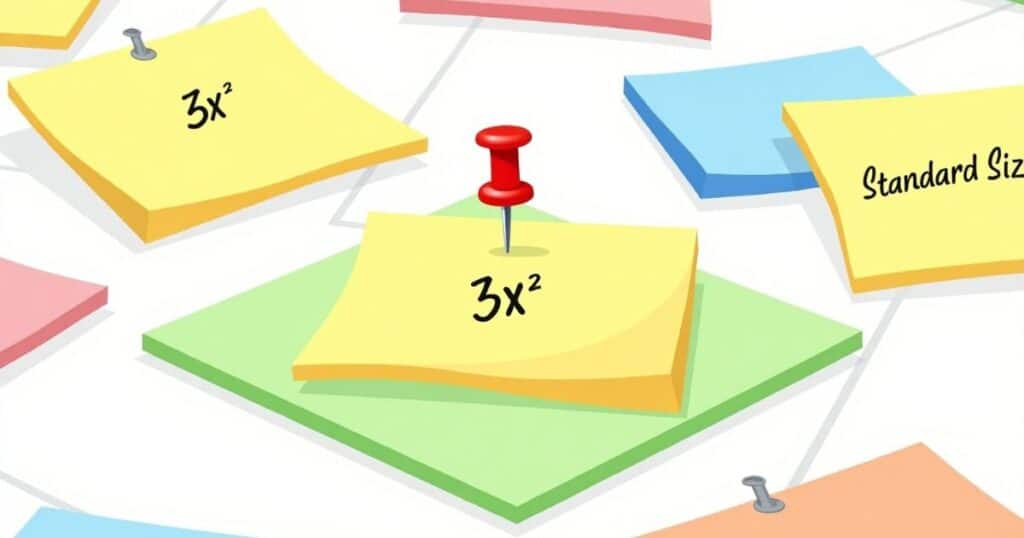
A standard sticky note measures 3×3 inches (76×76 mm), creating a perfect square that’s large enough to hold a thought yet small enough to be placed almost anywhere.
This size isn’t random—it fits comfortably in your hand, provides enough space for a short reminder, and doesn’t overwhelm documents or surfaces.
Think of it as slightly smaller than a playing card, making it instantly recognizable and ideal for everyday use.
The Evolution of Sticky Note Dimensions
The Original 3×3 Post-it® Note
In 1974, 3M scientist Spencer Silver accidentally created a “low-tack” adhesive that would stick to surfaces but could be easily removed without leaving residue. But it wasn’t until his colleague Art Fry, frustrated by paper bookmarks falling out of his hymnal, realized the adhesive could serve as a new kind of bookmark—one that wouldn’t damage pages.
After testing, the 3×3 inch size was chosen—large enough to write a note but small enough not to be obtrusive. “We didn’t want to overwhelm the document,” Fry explained. “The note needed to flag attention without hiding what was underneath.”
When Post-it® Notes launched nationally in 1980, the 3×3 inch size became an instant hit. The iconic canary yellow color was a happy accident—picked because it was the only scrap paper available during development.
With roughly 8.5 square inches of writable space, the size is perfect for the average short message most people write on sticky notes.
Expanding the Family: Various Sticky Note Sizes
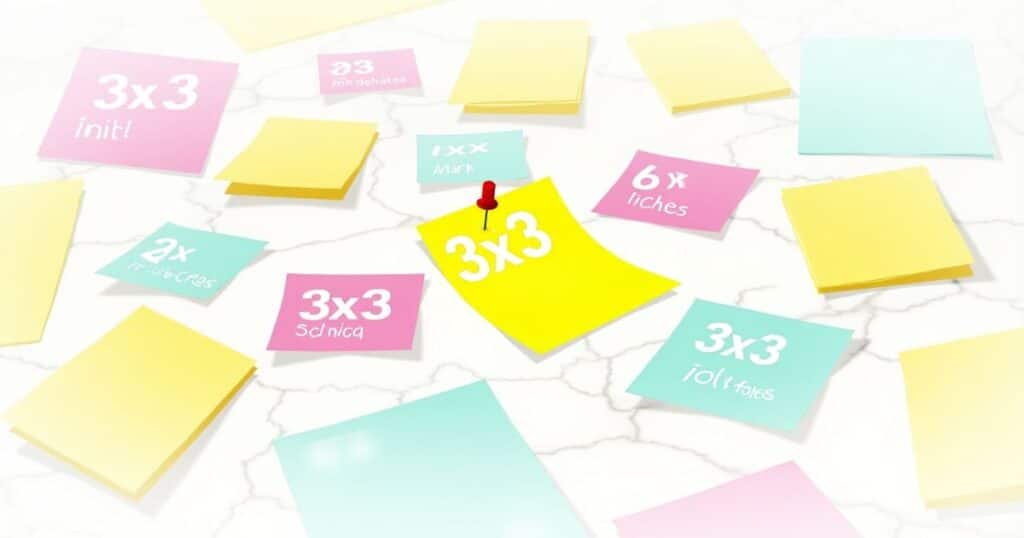
As sticky notes became more popular, manufacturers introduced different sizes to meet various needs:
Mini Sticky Notes (1.5×2 inches)
These tiny notes are perfect for brief reminders or marking pages. They’re great for quick notes like “Sign this” or “Call back” without taking up much space on your desk or planner.
The Legal Pad Style (3×5 inches)
These slightly larger rectangular notes provide more space for more detailed instructions or lists, often found in offices where more written space is needed.
The Jumbo Note (4×4 or 4×6 inches)
For making a statement or leaving detailed instructions, jumbo notes provide ample space for diagrams, multiple paragraphs, or notes that need to be shared. These are commonly used by teachers or presenters for brainstorming sessions or important notices.
See Also: Staple Sizes – Sizes of Common Objects and Stuff
The Science Behind Sticky Note Dimensions
The size of the standard sticky note isn’t arbitrary; it’s based on an understanding of human psychology and ergonomics.
Visibility Threshold
Research suggests that objects need to be a certain size to capture attention without conscious effort. A 3×3 inch sticky note hits the perfect balance—large enough to notice but not too large to be distracting. Notes smaller than 2×2 inches are often overlooked, while those larger than 4×4 inches can feel cluttered.
Writing Space Psychology
The average adult handwriting needs about 0.25-0.3 inches of vertical space per line. A 3×3 inch note comfortably accommodates 5-6 lines of text, forcing concise communication. Dr. Melanie Thompson, a cognitive psychologist, notes that limited space improves clarity because people prioritize the most important information.
Adhesive-to-Paper Ratio
The standard sticky note design uses about 15-20% of its surface for the adhesive strip, ensuring the note stays in place under normal conditions while still being easy to reposition.
Practical Applications of Different Sticky Note Sizes
Office Communication
Different sticky note sizes serve different purposes in office settings:
- Standard 3×3 notes work well for quick reminders on desks or computer monitors.
- Larger 4×6 notes are ideal for more detailed instructions or feedback.
- Mini notes are used for marking specific sections in reports without obscuring text.
Personal Organization
For personal use, sticky notes help externalize memory:
- Mini notes are perfect for marking calendar dates.
- Standard notes are great for shopping lists or daily to-dos.
- Larger notes can hold weekly meal plans or project steps.
Creative and Educational Uses
Sticky notes are used in creative and educational methods:
- Writers use them for storyboarding.
- Developers track project features using sticky notes.
- Teachers use them for interactive classroom activities.
Environmental Considerations of Sticky Notes
While sticky notes are undoubtedly useful, their environmental impact is worth considering.
Material Usage
A standard 3×3 sticky note uses about 0.07 square feet of paper. An average office worker uses 5-10 notes daily, adding up to about 1,800 notes annually.
Many manufacturers now offer recycled paper options, and some have reduced paper weight to lower material consumption.
Recyclability Challenges
The adhesive strip on sticky notes can complicate recycling processes. However, some companies now offer more environmentally friendly adhesives that break down more easily during recycling.
See Also: Thank You Card Sizes (Standard & Other Sizes)
Users can also cut off adhesive strips before recycling or switch to reusable alternatives like whiteboards for temporary notes.
Digital Alternatives to Physical Sticky Notes
As the world becomes more digital, virtual sticky note applications have emerged, offering several advantages:
- They never run out or fall off.
- They can be searched and categorized across devices.
- They eliminate paper waste.
However, studies suggest that digital sticky notes don’t have the same psychological impact as physical ones. Writing and posting physical notes resulted in 33% better information recall compared to typing digital notes.
Finding the Right Balance
Many productivity experts recommend a hybrid approach:
- Use physical sticky notes for immediate, high-visibility reminders.
- Use digital solutions for long-term storage and organization.
The key is to be intentional about which medium best serves each purpose rather than relying on just one.
DIY Custom Sticky Notes
You can easily create custom-sized sticky notes:
- Cut paper to your preferred size.
- Apply a thin strip of removable adhesive along one edge.
- This is especially useful for specialized applications like architectural plans or craft projects.
Conclusion
The standard 3×3 inch sticky note has endured for over four decades because its dimensions perfectly serve its purpose. It’s large enough to capture a thought, small enough to place anywhere, and designed to maximize utility while minimizing waste.
Whether you use them sparingly or have your entire monitor framed with colorful reminders, understanding the design behind these paper squares can help you use them more effectively.
Next time you grab a sticky note, take a moment to appreciate how its carefully calculated dimensions make it the perfect tool for capturing your thoughts. And as you look around, consider how many different-sized sticky notes you use—and if you’re making the most of each one.