Have you ever wondered why playing cards feel just right in your hands or why some cards shuffle better than others? The secret lies in their perfectly engineered dimensions. From poker nights to magic performances, playing cards have become ingrained in our culture, with their precise measurements playing a key role in how we experience card games and performances.
Whether you’re a casual player, a professional magician, or a curious collector, understanding the sizes of playing cards opens up a fascinating world where even tiny variations make a huge difference.
Let’s dive into the world of playing card dimensions and explore why these seemingly simple rectangles of cardstock deserve more attention.
How Big Are Standard Playing Cards?
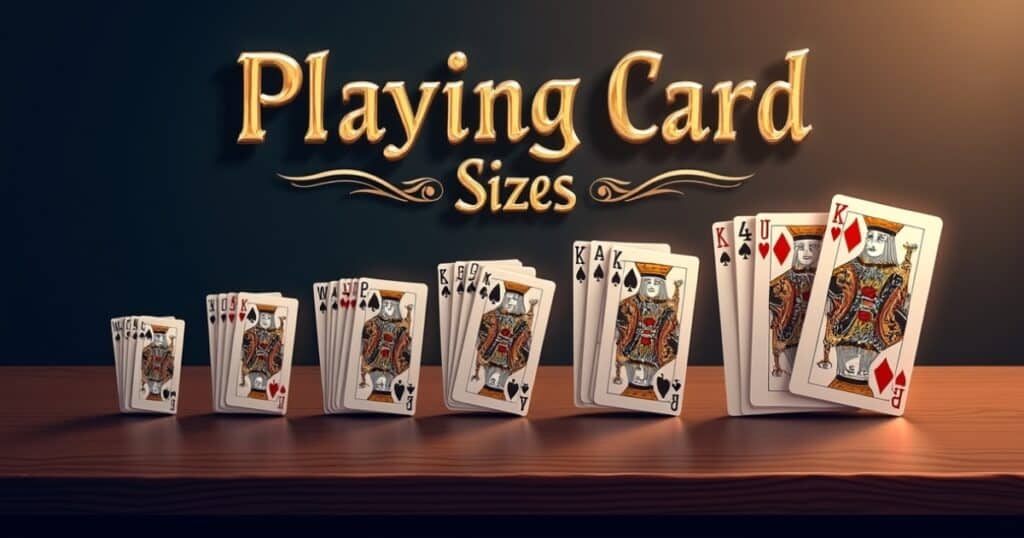
Standard poker-sized playing cards measure 2.5 inches (63.5mm) wide by 3.5 inches (88.9mm) tall. These dimensions are no accident—they create the perfect balance between comfort in handling and clarity in design. You’ll find these proportions from Las Vegas casinos to your family’s game night.
They fit comfortably in most hands, shuffle easily, and display their information clearly without overwhelming a tabletop.
Bridge Size vs. Poker Size: A Classic Rivalry
In the world of playing cards, there are two main standard sizes that have battled for popularity for generations:
Poker Size Cards dominate the American market and most casino settings. At 2.5″ × 3.5″ (63.5mm × 88.9mm), they offer ample space for card faces while maintaining excellent handling properties. The extra width compared to bridge cards provides stability when dealing and makes corner indices easier to read.
What makes poker cards so popular? Their extra width provides a stable platform for dealing face-up cards, like in Texas Hold’em, and allows for more intricate designs and artwork, which are key considerations for modern deck creators and collectors.
Poker cards also provide a satisfying snap when flicked or shuffled, thanks to their larger surface area interacting with the air. This tactile sensation is one of the small but enjoyable aspects of handling a quality deck.
Bridge Size Cards are narrower, measuring 2.25″ × 3.5″ (57mm × 88.9mm). This size developed historically for the game of bridge, where players need to hold more cards at once.
Bridge cards are great for players with smaller hands or those holding many cards simultaneously. The narrower width makes it easier to fan the cards out and hold them comfortably, especially in competitive bridge tournaments, where holding 13 cards at once can be a challenge.
Mini Cards: Compact Play
When regular-sized cards won’t do, mini playing cards step in. Measuring approximately 1.75″ × 2.5″ (44mm × 63mm), these tiny decks offer all the functionality of their larger counterparts, but with the added advantage of portability.
Mini cards are perfect for travel, fitting easily into jacket pockets, purses, or backpacks where regular-sized cards might be too bulky. They’re popular for camping, long flights, or impromptu entertainment. Despite their small size, quality mini decks maintain usability by adjusting the indices and designs to ensure readability.
I once saw a magician performing an incredible sleight-of-hand routine with mini cards on a crowded subway train. The small size made it possible to perform in spaces where regular cards would have been too difficult to manipulate.

Jumbo Cards: Bigger for Impact
On the other end of the scale, jumbo cards measure approximately 3.5″ × 5″ (89mm × 127mm) or larger. These oversized decks are used in situations where visibility is more important than handling ease.
Jumbo cards are excellent for teaching or performing to large audiences. They’re also invaluable for those with visual impairments who find standard-sized cards too hard to read.
They also have an entertainment value. Jumbo cards create a visual impact and often serve as conversation starters. Children love handling these oversized cards that seem like “grown-up” objects now turned into toys.
Magic performers frequently use jumbo cards as a visual effect in their acts, often transforming a standard card into a jumbo version for dramatic flair.
Specialized Playing Card Sizes
Beyond the standard sizes, specialized cards serve unique needs with their own dimensions:
- Tarot Cards typically measure 2.75″ × 4.75″ (70mm × 120mm), taller than standard cards. This elongated format allows for the detailed artwork necessary for tarot readings and symbolism.
- Collectible Card Games (CCGs), like Magic: The Gathering, use 2.5″ × 3.5″ (63.5mm × 88.9mm) cards, identical to poker-sized playing cards, making it easy for players to use standard sleeves and storage solutions. Japanese CCGs, like Yu-Gi-Oh!, use slightly different dimensions, measuring 2.125″ × 3.125″ (59mm × 86mm), requiring specialized storage.
- Spanish Playing Cards (Baraja Española) measure approximately 2.4″ × 3.5″ (61mm × 88mm), a little narrower than poker cards. The dimensions maintain the clarity and artistic detail necessary for these uniquely styled decks.
See Also: Scrabble Board & Tile Sizes: The Complete Guide
The Materials Matter: Card Stock and Thickness
Card thickness is just as crucial as size when it comes to card performance and durability:
- Casino-Grade Cards are often 0.3mm thick (0.012″) and made from durable materials like PVC or cellulose acetate. This construction resists bending and maintains a flat shape after thousands of shuffles.
- Bicycle Cards are typically 0.3mm thick, with premium versions reaching 0.32mm for enhanced durability.
- The thickness of a card directly affects its shuffling performance. Cards that are too thin bend too easily, while those that are too thick resist the natural flow needed for a smooth shuffle.
Why Size Consistency Matters
The precision of card dimensions isn’t arbitrary—it serves several crucial functions:
- Shuffling Mechanics rely on consistent card sizes. Variations in card dimensions can cause cards to catch or stick during shuffling, revealing positions to observant players.
- Game Fairness demands uniformity. In competitive environments, consistent dimensions ensure cards aren’t marked or altered in ways that would create an unfair advantage.
- Sleeve Compatibility is another reason for standardization. The vast market for protective card sleeves depends on predictable dimensions for a perfect fit.
Practical Applications: Choosing the Right Card Size
Understanding the dimensions of playing cards helps you select the appropriate deck for different settings:
- For Professional Environments like casinos or tournaments, poker-sized cards (2.5″ × 3.5″) are the standard, ensuring familiarity and comfort.
- For Home Games, consider the hand sizes of players. Bridge-sized cards (2.25″ × 3.5″) are better for those with smaller hands or for games requiring many cards.
- For Travel, mini cards are invaluable for packing light without sacrificing fun.
See Also: Checker Board Dimensions: Everything You Need to Know
How to Measure Playing Cards Without a Ruler
Don’t have a ruler? Use common objects for comparison:
- A business card measures 3.5″ × 2″ (89mm × 51mm), slightly smaller than a poker card.
- Credit cards are 3.375″ × 2.125″ (85.6mm × 54mm), a little smaller than poker cards.
- A dollar bill is 6.14″ × 2.61″ (156mm × 66.3mm)—about twice the size of a poker card in length and width.
Conclusion
The dimensions of playing cards, while seemingly simple, are the result of centuries of refinement aimed at creating a perfect balance of functionality, durability, and aesthetic appeal. Whether you’re shuffling a bridge deck for game night or handling a tarot spread, the size and feel of the cards have a direct impact on your experience.
Next time you pick up a deck, take a moment to appreciate the precision behind those 2.5″ × 3.5″ rectangles—or whatever size you prefer—and consider the hundreds of years of design evolution that have made them so perfect for your hands.
Look around your home—how many objects share similar dimensions to playing cards? From smartphone screens to small notebooks, you may be surprised at how this iconic rectangular shape has influenced design far beyond the card table.
Understanding playing card dimensions enhances your appreciation for these simple yet expertly engineered objects that continue bringing people together around tables worldwide.